Missed Call Text Back: How It Works and What to Send
Missed Call Text Back: How It Works and What to Send

Missed call text back is an automatic text message sent to a caller the moment you fail to pick up. It gives them a way to carry on the conversation straight away instead of ringing the next business on the list. For a small UK business, the value is speed: the caller hears from you while they are still deciding who to hire. I’m Joshua Adams-Peltier, and at TheAutoHaus I set this up as a fixed-price system that catches every enquiry, replies instantly and goes live in 5 working days. Below is how it works, what the first text should say, and the UK rules to stay inside.
TL;DR
- Missed call text back sends a short SMS to anyone whose call goes unanswered, so the enquiry carries on by text instead of ending in voicemail.
- The first message should be short, name your business, say you’ll help, and ask one easy question. Keep promotion out of it.
- Under UK rules, a neutral reply to someone who just rang you is treated differently from a marketing text. Sending offers later needs consent or a valid soft opt-in.
- The text is only the first step. Replies need an owner, a notification and a record, or the enquiry still goes cold.
- TheAutoHaus offers Never miss a job at £295 one-off, with an optional care plan at £35 per month.
Table of Contents
- What missed call text back actually does
- How the process works from call to reply
- What the first text should say
- The UK rules: PECR, soft opt-in and what counts as marketing
- Setting it up: what to decide before anything is built
- Where it fits beyond trades
- Mistakes that waste the feature
- Does it replace answering the phone?
- How TheAutoHaus can set it up for you
- What to do this week
- FAQ
- Sources
What missed call text back actually does
When a call to your business number isn’t answered, because you are on a roof, under a car, with a client or simply on another line, the system recognises it as a missed call and sends the caller an SMS. The caller replies by text, and you or your team pick it up from there.
That sounds small, but it changes what a missed call is. A voicemail asks the caller to wait and hope. Many people don’t leave one at all. They hang up and ring someone else. A text arriving seconds later puts your name back in front of them at the exact moment they are comparing options.
The feature suits any business where the phone is the front door:
- trades and home services, where you are physically unable to answer;
- garages, clinics and salons, where staff are with a customer;
- schools, tutoring and training providers, where enquiries land in term-time rushes;
- e-commerce and logistics firms, where customers ring about a delivery and the line is busy.
The mechanics are simple. The real work is in what happens around the text.
How the process works from call to reply
There are four moving parts, and a missed call text back only works well when all four are in place.
- Call handling. Your business number needs to route unanswered or busy calls to the system. This is the part most people underestimate, because the number your customers already know has to keep working as it does today.
- The trigger. The system decides a call is genuinely missed (not answered, busy, or rejected) and fires one text, not several.
- The message. A prepared reply goes to the caller’s mobile number. Landlines can’t receive texts, so a sensible set-up handles those calls differently.
- The reply path. When the caller answers, you are notified and the conversation is logged in one place, so nothing sits unseen in someone’s phone.
The first three are what the ranking guides on this topic spend their time on. The fourth is where enquiries are won or lost. A text that goes out instantly but whose reply sits unread until Thursday has only moved the silence.
This is why I build it as part of a wider enquiry flow rather than as a standalone gadget. In my work, I map how enquiries actually arrive and who deals with them, then build the system around the people who use it. Projects include practical documentation, exception handling and handover, so you know what happens when something unusual comes in.
What the first text should say
The first text has one job: make replying easy. Keep it to two or three short sentences.
A good first message does four things:
- names your business, so the caller knows the text is genuine;
- says you can’t take the call right now but will help;
- asks one simple question that moves things forward;
- tells them they can reply to this number.
Here are examples in plain UK English.
A trades business:
Hi, this is Jones Plumbing. Sorry we missed your call, we’re on a job. What do you need help with, and what’s your postcode? We’ll come back to you shortly.
A salon or clinic:
Hello, thanks for calling Harbour Clinic. We’re with a patient at the moment. Reply with what you’re looking for and a good time to talk, and we’ll get back to you.
A school or training provider:
Thanks for calling. We can’t pick up right now. Which course or term are you asking about? Reply here and a member of the team will respond.
An online shop:
Hi, you’ve reached the customer team. Sorry we missed you. If it’s about an order, reply with your order number and we’ll look into it.
These are templates to adapt, not real client messages. Notice what they leave out: no discount codes, no “book now for 10% off”, no links to a promotion. That is not only good manners. It matters legally, as the next section explains.
Handling the caller’s reply
Asking a question is the easy part. Decide beforehand what happens when the answer arrives:
- Who sees it? One named person or a shared inbox, not “whoever is nearby”.
- How fast do you reply? Set a working-hours standard you can actually meet, and say so in your own team notes.
- What if it’s urgent? A burst pipe or a failed delivery should be flagged differently from a price enquiry.
- What if the caller never replies? Decide whether you try once more by phone, and when you stop.
- Where does it end up? The number, the message and the outcome should land in the same record as your other enquiries.
This is the exception handling that makes the difference between a neat idea and a system the team trusts.
The UK rules: PECR, soft opt-in and what counts as marketing
In Britain, text messages are covered by the Privacy and Electronic Communications Regulations, known as PECR, enforced by the Information Commissioner’s Office (ICO), the data protection regulator. This is the part most generic guides, often written for other countries, skip.
A reply to a call versus a marketing text
The ICO’s guidance explains that routine customer service messages are not direct marketing, and that general branding or a logo doesn’t turn a message into marketing, whereas significant promotional material does. Its guidance on regulatory communications adds that a neutral-toned message with no active promotion is unlikely to be direct marketing, while one that highlights benefits and encourages a particular action is likely to be. It also says that adding a marketing element to a routine service message doesn’t stop it being direct marketing.
The practical rule for your first text is therefore straightforward: answer the call, ask what they need, and stop there. A “sorry we missed you, what can we help with?” message is a response to their own call. A “sorry we missed you, here’s 15% off this week” message is a different thing.
When you want to send offers later
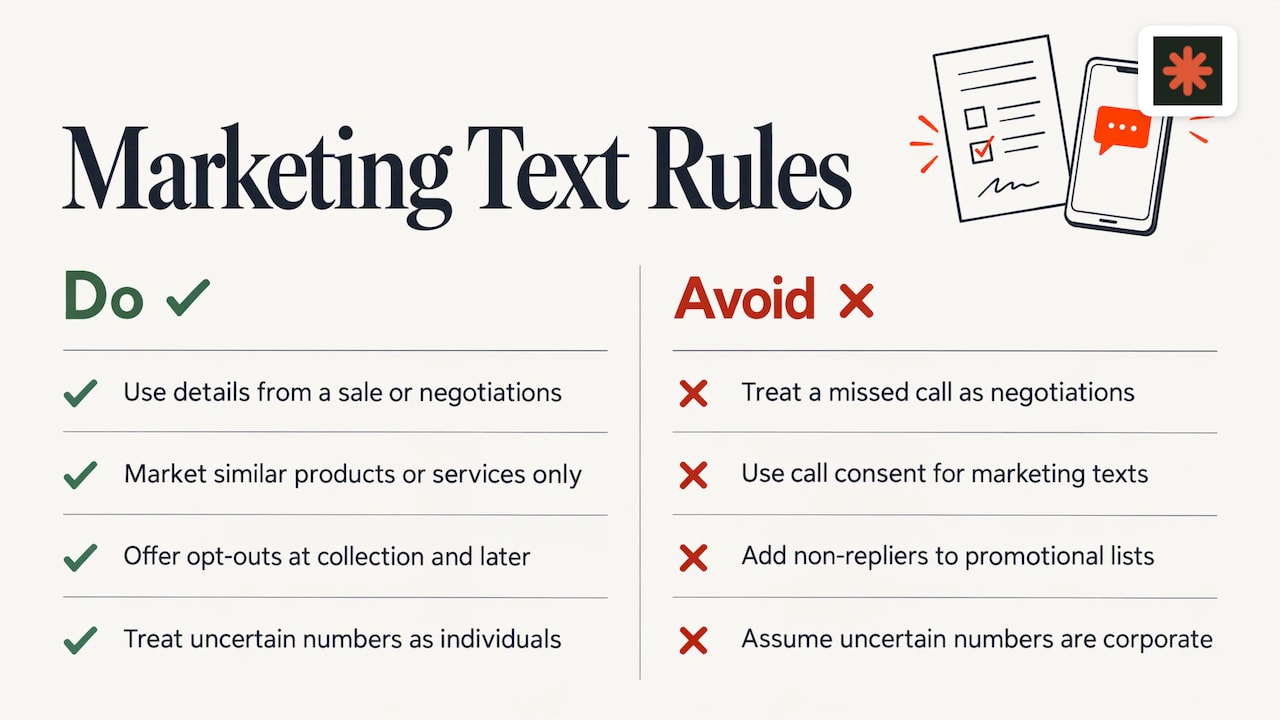
PECR regulation 22 prohibits sending unsolicited direct marketing by electronic mail to individual subscribers unless they have previously consented, with a narrow exception known as the soft opt-in. The regulation on legislation.gov.uk says that exception needs details obtained in the course of a sale or negotiations, marketing of similar products or services only, and a simple way to opt out both when details were collected and in every later message.
One point catches businesses out. The ICO’s guidance says a missed call on its own is not “negotiations for the sale”, because there has to be express communication about buying, and consent to use a number for calls doesn’t cover marketing texts. So a caller who rang once and never replied should not drop onto a promotional list.
The same guidance says the electronic mail marketing rules don’t apply to corporate subscribers, so B2B marketing texts to companies are permitted. Sole traders and some partnerships count as individuals, though, and if you can’t tell, treat the number as belonging to an individual.
The ICO has flagged that its electronic mail marketing guidance is under review following changes made by the Data (Use and Access) Act, so check the ICO’s pages for the current position before building any marketing sequence.
Why it’s worth getting right
The government’s response on director liability set out that the ICO can issue civil monetary penalties of up to £500,000 for PECR breaches, and that since 17 December 2018 fines of up to £500,000 can also be imposed on individual directors who consent to, connive in or neglect to prevent serious contraventions. If you are unsure whether a particular follow-up text is marketing, ask your data protection adviser or check the ICO’s guidance before it goes live.
Setting it up: what to decide before anything is built
Whether you build it yourself or have it built, the same decisions come up. Getting them right on paper first saves the rework later.
1. Which numbers and which calls
List the numbers customers actually ring: the main line, a mobile, a Google Business Profile number. Decide which calls count as missed. A call that rings out is obvious. A call answered by a colleague who then drops it is not.
2. What the text says, in your voice
Write it as you would speak to a customer. Use your trading name. Keep to one question. Avoid emojis and links in the first message if you want it to read like a person who is busy, not a broadcast.
3. Opening hours
A text at 11pm saying “we’ll help right away” sets a promise you can’t keep. Write one version for in-hours and another for out-of-hours that says when you will reply.
4. Who owns the reply
Name a person for each type of enquiry: quotes, bookings, delivery queries, admissions questions. If two people assume the other has it, the customer gets nothing.
5. Where the record lives
Every missed call, every text and the outcome should sit in one place. Without that, you cannot tell how many enquiries you are losing or winning.
6. What happens next
A text reply is rarely the end. It should lead to a booking, a quote, a call back or a case in your order system.
This is the routine I walk through in a fixed-price setup. Never miss a job is built to catch every enquiry and reply instantly, and it goes live in 5 working days, so the decisions above are settled once with someone who does this for small service businesses, not left to be improvised on a busy Monday.
Where it fits beyond trades
Most searches for this feature come from trades and local services, but the same pattern helps other operations.
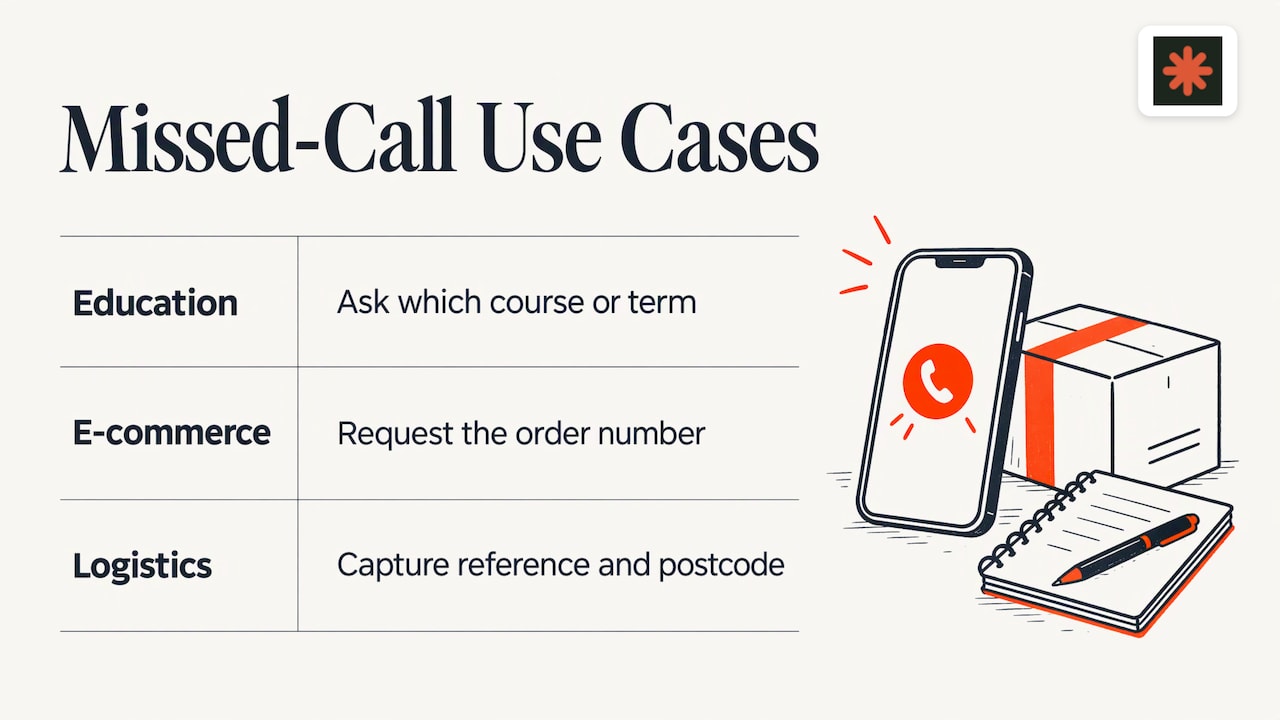
Education. Enquiries about courses, term dates and places come in waves, and a missed call is often a parent or learner comparing several providers. A first text asking which course they mean gets the enquiry into a structured process. My enquiry-to-booking education pipeline shows how I think about moving an education enquiry through to a booking.
E-commerce. A missed call from a customer is usually about an order that is late, wrong or unclear. Asking for the order number in the first text lets the right person find it before calling back. For the order side of that, see how I approached order to dispatch in a real project.
Logistics. Delivery queries are time-sensitive. A text that captures a consignment reference and a postcode, and routes it to whoever owns that route, is far more useful than a voicemail nobody checks until the afternoon.
In each case the text is the front end. The value comes from what it connects to: a booking system, an order database, a shared inbox. That is why I build the surrounding workflow, using tools such as Airtable, n8n, Make and APIs, alongside the message itself.
Mistakes that waste the feature
These are the ones I would watch for.
- Sending several texts for one call. One call, one message. Repeats look like spam and irritate people.
- A long, salesy first message. It reads like an advert and, as covered above, can drift into marketing territory.
- No notification on reply. If nobody is alerted, the customer is waiting in a silent inbox.
- Texting numbers that can’t receive texts. Landlines and withheld numbers need a different route.
- Treating every caller the same. An existing customer, a supplier and a new enquiry want different handling.
- Not measuring. Track how many calls were missed, how many people replied, and how many became work. Even a simple count each month tells you whether it is paying for itself.
Does it replace answering the phone?
No, and it isn’t meant to. You still answer when you can. The text covers the gaps: the call you couldn’t take, the one that came in while you were with a customer, the one after hours. It makes sure those gaps don’t become lost work.
How TheAutoHaus can set it up for you
If you run a trade, garage, clinic, salon or similar small service business and you are tired of losing enquiries to voicemail, Never miss a job is the fixed-price setup I built for exactly this. It catches every enquiry, replies instantly and is live in 5 working days. The price is £295 one-off. If you’d like ongoing support, the care plan is £35 per month.
If your needs are wider, such as order management, production workflows or an operations system that links enquiries to the rest of your business, TheAutoHaus builds custom workflow automation, operations systems and web development around how your team really works. You can see the kind of projects I take on in the portfolio.
What to do this week
Write down how many calls you think you miss in a typical week. Draft the first text in your own voice, using the examples above. Decide who owns the replies. Then get the whole thing running, so the next missed call becomes a conversation instead of a lost job. If you want more practical write-ups on small-business systems, the TheAutoHaus blog is where I publish them.
FAQ
What is missed call text back?
It is an automatic SMS sent to someone whose call to your business wasn’t answered. It lets them reply by text straight away, so the enquiry continues rather than ending at voicemail. You or your team then pick up the conversation when you are free.
How do you text back when you missed a call?
If you are doing it by hand, send a short message as soon as you can: say who you are, apologise for missing the call and ask what they need. An automatic setup does the same thing within moments, every time, including when you are busy or out of hours.
Is a missed call text a marketing message under UK law?
A neutral reply to someone who has just rung you, with no promotion, is unlikely to be direct marketing according to the ICO’s guidance. Adding offers can change that. Marketing texts to individuals need consent or a valid soft opt-in, so keep the first message to the enquiry.
What should my first missed call text say?
Name your business, say you can’t talk right now but will help, and ask one simple question such as what they need or their postcode. Keep it to two or three short sentences, with no discount codes or promotional links.
How much does a missed call text back setup cost with TheAutoHaus?
Never miss a job is a fixed-price setup at £295 one-off, and it goes live in 5 working days. There is also an optional care plan at £35 per month.
Sources
- Electronic and telephone marketing | ICO
- Electronic mail marketing | ICO
- Direct marketing and regulatory communications | ICO
- ICO soft opt-in and B2B marketing guidance (IC-486566)
- The Privacy and Electronic Communications (EC Directive) Regulations 2003, legislation.gov.uk
- Government response on director liability for nuisance calls and messages, December 2018